AI-Based Surface Defect Detection
Detecting scratches, stains, holes and wrinkles on the surface of moving material with a camera, tracking each defect with the encoder, and marking or rejecting it.
Read more
Surface defects, missing parts, wrong prints, out-of-tolerance dimensions, randomly placed parts and failures in the making. ONX Control sees them with an NVIDIA Jetson-based edge computer, GigE cameras and open tools on Linux next to the line, and wires the decision into the PLC, servo axes and EtherCAT network.
The model runs on an edge computer next to the line. Images and machine data are not sent to the cloud; the system works without internet access.
Camera trigger, inference and the reject or robot command happen on the line itself, timed by encoder position; no network round trip in between.
Ubuntu-based NVIDIA JetPack, TensorRT, ONNX Runtime, YOLO, OpenCV and Python. Models and code stay yours, not locked into one vendor's closed software.
The same team builds the vision side, the line PLC, the servo axes and the EtherCAT network. The AI decision is wired straight into the machine's motion.
Each page explains how the application works, which parameters matter, how it is added to an existing line and how the project is validated. The card animations show the working principle.
Detecting scratches, stains, holes and wrinkles on the surface of moving material with a camera, tracking each defect with the encoder, and marking or rejecting it.
Read moreVerifying with a camera that the screws, connectors, seals and labels on every assembled part are present, correctly oriented and of the right type.
Read moreReading date, lot and serial number prints on packaging and parts and checking them against the recipe; keeping a traceability record with DataMatrix codes and barcodes.
Read moreMeasuring part length, diameter, hole position and profile cross-section without contact using a calibrated camera, and sorting parts by tolerance.
Read moreFinding surface defects on wet blocks at the vibro-press outlet with AI, measuring every block's height with a laser line and reporting the result per pallet to the operator.
Read moreFinding the position and angle of randomly placed parts on a conveyor with a camera, tracking them with the encoder and picking them on the move with a robot or servo axes.
Read moreClassifying and counting products on a conveyor with a camera and diverting them to the correct lane with encoder-timed air jets or flaps.
Read moreLearning a machine's normal behaviour from drive current, torque, speed and temperature data and from vibration sensors, and flagging deviations before a failure occurs.
Read moreDetecting people entering defined zones around a machine with a camera and warning them; a supplementary layer alongside certified safety equipment.
Read moreA separate camera box saying "defective" is not enough; the decision must reject the right product, correct the cut length, guide the robot or schedule maintenance. In the flying shear, smart belt, packaging, winding and CNC solutions ONX builds, the encoders, servo axes and EtherCAT network are already in place, and the AI result connects straight into them.
The length and cut quality of every piece can be measured by camera at the end of the line. The trend of the measured deviation is fed back to the flying shear's cut-length correction, so measuring-wheel slip or wear is caught before parts drift out of tolerance. The servo torque trace of each cut cycle shows the condition of the carriage, blade and drive mechanics for predictive maintenance.
Defects on film, foil, paper or strip are recorded on the same position axis as the winder's metre counter and the line encoder. Each reel's defect map is therefore stored together with its tension and speed log, and the cause (tension swings, a splice, the die) can be traced on one timeline. On a slitting line the defective section can be removed at the reel change.
Defects in fabric and yarn can be found by camera while the material moves. In pocket setting and sewing automation the fabric edge, pattern or mark is located by camera and the servo axes' stitch path is corrected to the part's real position, within the same ONX motion application and without a separate vision controller.
Date, lot and DataMatrix prints are read at the packaging machine's outfeed, compared with the machine's active recipe, and faulty packs are rejected. On thermoformers and tray sealers, product presence and placement in each cavity can be checked before sealing. Reject timing is tied to the machine's master axis position, so the right pack is removed even when speed changes.
A camera placed instead of, or next to, the photocell gives the product's position, orientation and defects at once. The position feeds the phasing belt's correction; flipped, broken or incomplete products are rejected before they reach the wrapper. Since the smart belt already has encoders and servo axes, the vision result connects straight into motion control.
The position and angle of a sheet or part placed anywhere on the table are found by camera and passed to X CNC Library's work coordinate system (origin and rotation), shortening manual referencing. On glass and wood, the sheet edge and defective areas can become inputs to the cutting or painting plan. The machined part's dimensions can be checked before it leaves the machine.
The x, y, θ from the camera and the encoder value at the moment of capture become a conveyor-tracking pick through X Motion's synchronisation and electronic cam functions. The Cartesian or SCARA axis group runs in the same CODESYS application, and the axes are sized with ONX Motion Sizing.
The bend angle of a formed part or the cross-section of a profile can be measured by camera, and the deviation is applied as a correction to the next part's axis target. On window machines, profile type, holes and fittings can be verified before processing.
On machines ONX builds and maintains, drive data is already on EtherCAT. Current, torque, temperature and vibration traces are monitored on the edge AI computer, and deviation alerts feed the planned visits in the maintenance contract. In retrofit projects, data collection can be built into the architecture from the start.
In cells built by ONX, the safety circuit is built separately in the panel with certified safety equipment. Camera zone monitoring can be added next to it as a warning and logging layer; it does not replace a safety function.
The edge AI computer is deployed in one of two ways. Which one fits is chosen together, based on line size, the existing control system and the motion requirements.
The camera connects to the edge computer; the result goes to the line PLC via digital outputs, Modbus TCP or OPC UA. Line control stays untouched; only trigger and result steps are added to the PLC program. The fastest route for running lines.
camera → edge AI → PLC → valve / robot
In small cells, CODESYS Control for Linux ARM64 SL runs as the PLC on the same Jetson device: the model on the GPU, the IEC 61131-3 application on the CPU. Vision results are written straight into PLC variables; no separate PLC is needed.
camera → Jetson (AI + CODESYS) → I/O
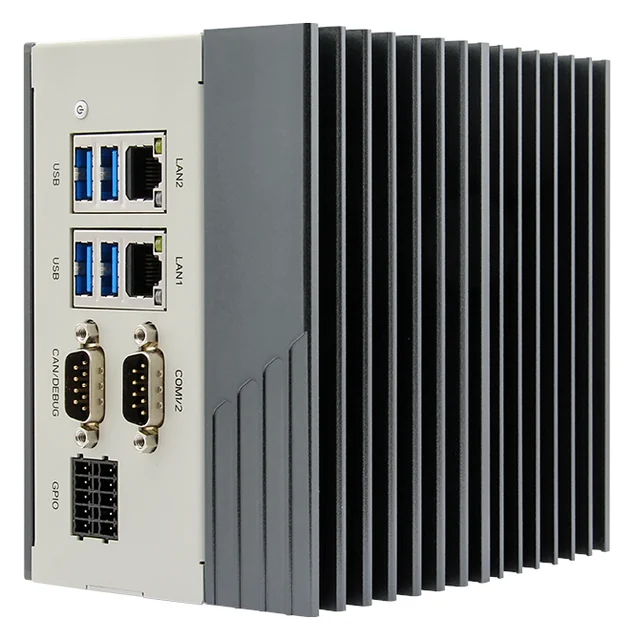
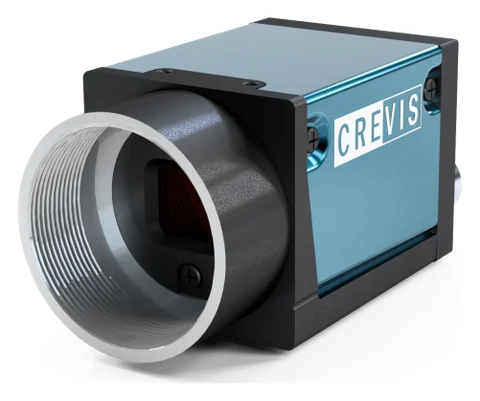
We supply the edge AI computer, cameras and lens for pilots and small cells from our Istanbul stock; the "In stock" badge on each card shows the current status. Faster or wider lines get hardware selected for the job.
In stock
Separate LAN ports for the camera and the PLC network; digital outputs can drive a reject valve or a warning light directly. M.2 SSD, 4G/5G and Wi-Fi slots, DIN rail and wall mounting. The TOPS figure is the manufacturer's rating.
In stock
Directly for stationary parts and stations; for moving products with Global Reset mode and a strobe. Fast-moving products call for the global shutter MG-A121K-9, also in stock. Single-cable PoE; if the edge PC port is not PoE, a PoE injector or switch is used.
Global shutter: all pixels are exposed at once, so moving products are not skewed. The in-stock choice for moving products, conveyor tracking and measuring parts in motion.
Used with the high-resolution cameras; the field of view is calculated from the working distance.
The "In stock" badge comes from our daily stock data; quantities are not shown.
What must be found, the acceptance criterion and good/bad samples are defined together.
Camera, lens and lighting are tested on the bench; the right image is half the job.
Images are labelled, the model is trained and converted for the edge device.
False reject and escape rates are measured on your samples and reviewed with you.
The system first only records; its decisions are compared with operators and quality staff.
Decision mode goes live; new cases are recorded and the model is retrained with version control.
Classic machine vision uses hand-written rules such as edges, colour and thresholds; under uniform, controlled conditions it is fast, simple and explainable. Deep learning decides by learning from examples where rules are hard to describe: textured surfaces, changing light and many product variants. Projects usually combine both: AI finds the object or defect, measurement and rules use classic methods.
Reject, robot pick or line stop decisions must be made before the product leaves the line; network latency and outages put that at risk. An edge computer decides next to the line, and images and production data never leave the site.
On the edge, NVIDIA Jetson-based industrial computers (in our stock: Nexcom COEUS-3721T with Jetson Orin Nano 4 GB) and Crevis GigE cameras. In software, Ubuntu-based JetPack Linux, TensorRT and ONNX Runtime, YOLO-family models, OpenCV and Python, and where useful CODESYS Control for Linux ARM64 SL on the same device. Larger lines get hardware sized to the job.
Yes, most projects are added to a running line. The edge computer passes its result to the existing PLC via digital outputs, Modbus TCP or OPC UA; trigger and result steps are added to the PLC program. Space for the camera, lighting and reject mechanism and a line encoder signal are needed.
We define together what must be found, the acceptance criterion and good and defective samples. The first stage is a bench feasibility study: images are captured with the right camera and lighting, a first model is trained and the result is measured on your samples. The pilot and go-live are planned only after that result is accepted.
Delivery of the model trained on your images and of the application code is defined in the contract. Some open-source models and libraries carry licence conditions for commercial use; we clarify the licence of the chosen model together at the start of the project.
Tell us what you need to find, your line speed and share a few good and defective samples; we will propose a feasibility plan with camera, lighting and edge architecture.
By submitting this form, you confirm that you have read the Privacy Notice (KVKK) on how we process your personal data to respond to your request.