Crane Anti-Sway Control
In short
Anti-sway control is a motion control method that suppresses the pendulum swing of a rope-suspended load while a crane trolley or bridge accelerates and decelerates. The sway period depends only on rope length (T = 2π√(L/g)); knowing this period, the controller shapes acceleration and deceleration so that no sway builds up or it cancels itself, and can correct it in closed loop with a measured sway angle. ONX Control builds this control with CODESYS, EtherCAT and the trolley, bridge and hoist drives.
How it works
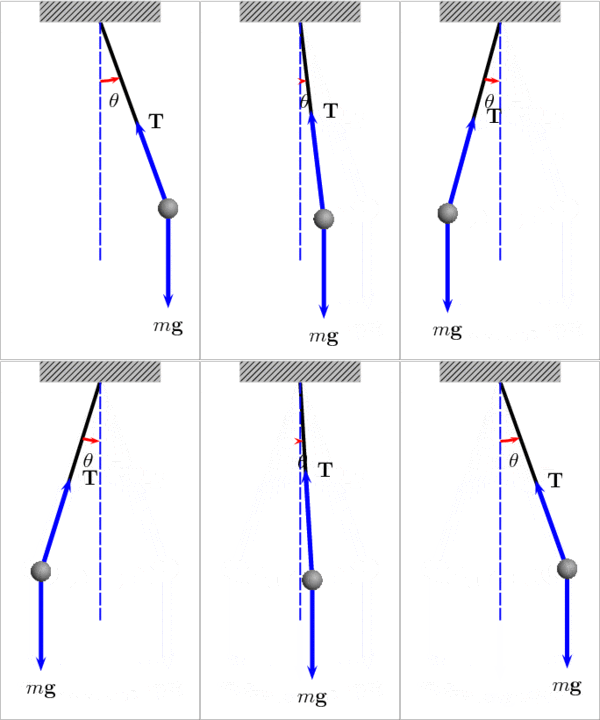
A rope-suspended load is a pendulum. For small angles its period is T = 2π√(L/g), where L is the rope length from the suspension point to the load's centre of gravity and g is gravitational acceleration. The period is independent of load mass: at a 4 m rope length it is about 4 seconds, and quadrupling the rope length doubles the period. When the trolley accelerates the load lags behind, and when it stops the load swings forward; damping this by hand takes the operator both time and skill.
In open-loop anti-sway the speed reference is shaped according to the sway period (input shaping). In its simplest form the acceleration is split into two parts, the second applied half a period after the first, so the sway caused by the first part is cancelled by the second. Because rope length is read continuously from the hoist encoder, the profile is recalculated for the current period even when the load is raised or lowered during travel. In the closed-loop method the sway angle is measured by a sensor and added as a correction to the trolley speed reference; this also damps sway started by external effects such as wind, picking up the load or an impact.
-
1
Measure rope length
The current rope length, and from it the sway period, is calculated from the hoist position and the suspension geometry.
-
2
Shape the speed profile
The speed command from the operator's joystick or from an automatic target is converted into an acceleration and deceleration profile shaped to the sway period.
-
3
Correct with sway angle
In closed-loop applications the measured sway angle and angular velocity are added as a correction to the trolley or bridge speed reference.
-
4
Coordinate trolley and hoist
Trolley, bridge and hoist motions are planned together; the changing rope length during hoisting is taken into account and the load arrives at its target settled.
Critical parameters
| Parameter | Why it matters | Typical range / ONX field data |
|---|---|---|
| Trolley / bridge speed and acceleration | Determine the size of the sway; high acceleration increases sway, while low acceleration lengthens the cycle. | Defined per project |
| Positioning accuracy and residual sway tolerance | Define how precisely the load is placed and the sway amplitude accepted at the end of the move. | Defined per project |
| Cycle time | The time from the start of the move until the load settles; the real gain of anti-sway is working without waiting for the load to settle. | Defined per project |
| Rope length range | Sets the sway period; with long ropes the period and the duration of the shaped profile increase. | Defined per project |
| Sway measurement | Closed loop needs an angle sensor, camera or inclinometer; measurement delay and noise limit the gain of the correction. | Defined per project |
ONX architecture
In the ONX architecture the trolley, bridge and hoist drives share one EtherCAT network. Rope length is read from the hoist position, and the sway period and shaped speed profile are calculated in CODESYS every cycle and sent to the trolley and bridge drives as speed references. In closed-loop applications the sway angle sensor is read through remote I/O or EtherCAT.
In manual mode anti-sway shapes the operator's joystick command; in automatic mode the load is carried along a trajectory planned to arrive at the target without sway. Hoist brake logic, speed limits and position limits are handled in the same CODESYS application.

CODESYS SoftMotion
Sway period calculation, shaped speed profiles, angle feedback correction and axis coordination.

Industrial PC
Industrial PC or panel PC running CODESYS Control RTE.

Trolley, bridge and hoist drives
AC drives receiving speed references over EtherCAT; closed-loop vector control with encoder and brake management on the hoist.

Motors
Induction motors for trolley, bridge and hoist motions.
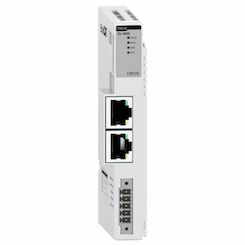
Remote I/O and sway sensor
EtherCAT remote I/O for the sway angle sensor, limit switches and brake feedback.
Field reference
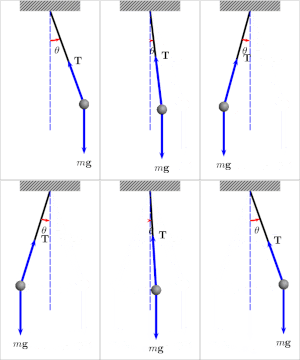
The images below illustrate the principle of anti-sway: a load swinging like a pendulum under uncontrolled acceleration, the same load carried calmly with an anti-sway profile, and a hoisting system carrying a suspended load.
Principle illustrations

Retrofit scenario
A typical picture on existing cranes: trolley and bridge motions run by stepped speed contactors or simple ramped drives, and an operator trying to damp the sway by hand. In a retrofit the crane mechanics are kept; trolley, bridge and hoist drives are replaced with EtherCAT drives, an encoder is added to the hoist to measure rope length, and anti-sway is implemented in software.
- Inspecting crane geometry, rope length range and the existing drives and motors
- Adding EtherCAT drives and, where needed, encoders to trolley, bridge and hoist axes
- Deciding between open-loop profile shaping and closed loop with sway angle measurement
- Implementing anti-sway in CODESYS for manual and automatic modes
- Commissioning with sway logging at different rope lengths and loads
Frequently asked questions
Why does the load sway?
A rope-suspended load is a pendulum. When the trolley accelerates, the suspension point moves before the load and the load lags behind; when the trolley stops, the load swings forward. The sway period depends only on rope length, not on load mass.
Is a sensor required for anti-sway?
Not for the open-loop method; if rope length is known from the hoist encoder, the speed profile is calculated so that no sway builds up. If sway started by external effects such as wind, picking up the load or an impact must also be damped, the sway angle is measured and a closed loop is built.
What happens if the load is raised or lowered during travel?
As rope length changes, the sway period changes too. Because the controller reads rope length continuously, it recalculates the speed profile for the current period; this is why trolley and hoist motions are planned together.
Does anti-sway change how the operator works?
In manual mode the operator uses the joystick in the same way; the controller shapes the command to cancel sway. Motion may feel slightly softer at first, but there is no need to wait for the load to settle at the target.
What information is needed for a quote?
Crane type and geometry, rope length range, load range, trolley and bridge speeds, manual or automatic operation, and the existing drive and control system are enough for a first assessment.
Discuss your crane project with our engineers
Share your crane type, rope length range and speed targets; we will come back with an anti-sway method and drive proposal.