Load Sharing Control
In short
Load sharing is a drive control method that makes two or more motors driving the same mechanical load share torque equally or in a defined ratio. If each motor is left in its own speed control, small speed differences make one motor pull the whole load while the other brakes; so typically one motor runs as a speed-controlled master and the others as torque-controlled slaves, or droop control is used. ONX Control builds this with CODESYS, EtherCAT and AC or servo drives running in speed and torque control modes.
How it works
Two motors that are rigidly coupled (on the same drum, shaft or belt) are physically forced to run at the same speed. If both drives chase their own speed reference, small errors from encoders, slip and reference mismatch make the speed controllers fight each other: one motor is overloaded and heats up while the other runs idle or even regenerates. Load sharing is set up to remove this conflict.
The three most common methods are the master/slave torque follower, droop control, and a slow torque balancing (trim) loop added to speed-controlled drives. In a torque follower, the master drive holds speed and its torque reference is sent to the slave drives as their torque reference in every communication cycle. With droop, each drive lowers its own speed reference slightly in proportion to its torque; no communication is needed, at the cost of some speed regulation. The right method differs between elastic couplings such as belts and rigid systems where motors share a shaft.
-
1
Define the coupling
Determine whether the mechanical link between motors is rigid (common shaft, common drum, gearing) or elastic (long belt, rope, chain); the method is chosen accordingly.
-
2
Master speed control
The master drive runs in speed control and sets the system speed; ramps, acceleration and deceleration are handled only through the master.
-
3
Slave torque following or droop
Slave drives receive the master's torque reference over EtherCAT and apply it multiplied by the sharing ratio; alternatively all drives run in speed control with droop.
-
4
Protection and monitoring
A speed limit is set on the slave so it cannot run away if the coupling breaks or the belt slips. Motor torques and currents are compared continuously and imbalance is reported as an alarm.
Critical parameters
| Parameter | Why it matters | Typical range / ONX field data |
|---|---|---|
| Line / travel speed | Sets the motor speed range, gear ratio and, with droop, the acceptable speed drop. | Defined per project |
| Load sharing accuracy | The accepted torque difference between motors; torque measurement accuracy and the drives' motor model tuning are decisive. | Defined per project |
| Response time and communication cycle | The time for the torque reference to travel from master to slave; determines how well sharing holds at start-up and under sudden load changes. | Defined per project |
| Coupling stiffness | A torque follower suits rigid couplings; elastic couplings (long belts, ropes) are better served by speed control plus a torque balancing loop. | Defined per project |
| Number of motors and power ratio | With motors of different ratings, the sharing ratio is defined in proportion to rated torque rather than equally; differences in motors and gearboxes are balanced in software. | Defined per project |
ONX architecture
In the ONX architecture, master and slave drives sit on the same EtherCAT network. CODESYS reads the master drive's actual torque every cycle, applies the sharing ratio, ramps and limits, and writes it to the slave drives as a torque reference. Thanks to EtherCAT's deterministic cycle, no separate analog torque line or special drive-to-drive wiring is needed.
For high-power applications, modular drive systems with a common DC bus such as Unidrive M000 can be used, so energy regenerated by one motor during braking is used by the others. Start-up sequence, brake release conditions, imbalance alarms and emergency operation on a single motor are handled in the same CODESYS application.

CODESYS and EtherCAT master
Passing the torque reference from master to slaves, sharing ratio, droop and torque balancing loops.


AC drives
Drives that run in speed and torque control and connect to EtherCAT through the SI-EtherCAT module; a modular common DC bus system for high power.

Motors and sizing
Induction motors for conveyor and hoist drives; motor selection based on load, incline and acceleration profile.
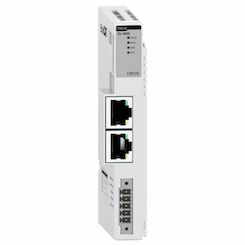
Remote I/O
EtherCAT remote I/O for brake feedback, belt slip and overspeed sensors and emergency stop signals.
Field reference
The images below illustrate the principle of load sharing: passing the master drive's torque reference to slave drives on mechanically coupled motors, and a conveyor driven from both ends.
Principle illustrations


Retrofit scenario
A typical picture on older multi-motor systems: several motors fed in parallel from one drive, an analog torque link between drives, or each motor left in its own speed control with the imbalance tolerated through motor slip. In a retrofit the motors and mechanics are usually kept; each motor gets its own drive and load sharing is implemented in software over EtherCAT.
- Inspecting the existing motors, gearboxes and mechanical coupling, and logging motor currents in operation
- Choosing torque follower, droop or torque balancing according to the coupling type
- Adding an EtherCAT drive for each motor and, where needed, an encoder
- Defining slave speed limits, brake logic and imbalance alarms in CODESYS
- Commissioning with torque sharing logged at no load, full load and start-up
Frequently asked questions
Why is load sharing needed? Isn't it enough to set the motors to the same speed?
Mechanically coupled motors are already forced to run at the same speed. If both drives are in independent speed control, reference and measurement differences make the controllers fight; one motor carries most of the load while the other idles or brakes. Load sharing distributes torque deliberately.
What is the difference between droop control and a torque follower?
With droop, each drive lowers its speed slightly in proportion to its torque; no communication between drives is needed, but a small load-dependent speed drop is accepted. With a torque follower, the master holds speed and sends its torque reference to the slaves; speed regulation is kept, but fast and reliable communication is required.
Which method suits long belt conveyors?
Because the belt is elastic, momentary speed differences can occur between head and tail drives. On such systems, speed control with a slow torque balancing loop, or droop, is often more stable than putting the slave directly into torque control. The decision depends on belt length, take-up system and load profile.
How is safety ensured on dual-motor hoists?
A speed limit is always defined for the torque-controlled slave, so it cannot accelerate uncontrolled if the coupling breaks or the load slips. Brake release is tied to confirming that both motors produce torque, and torque imbalance is monitored to raise alarms.
What information is needed for a quote?
Application type (conveyor, hoist, roll), number and rating of motors, type of mechanical coupling, speed range, load profile and the existing drive and control system are enough for a first assessment.
Discuss your multi-motor drive project with our engineers
Share the number and rating of your motors and how they are coupled; we will come back with a load sharing method and drive proposal.