
 Control Techniques
 Estun Automation
 CODESYS
 Crevis
 Nexcom / Nexcobot
 Leroy-Somer
 Servo Systems
 AC Drive + Motor
 DC Drives
 Smart PLC
 Panel PC / IPC
 Remote I/O
Predictive Maintenance with Drive and Motor Data
By the ONX Control engineering team · Last updated:
In short
Predictive maintenance is a maintenance approach that learns a machine's normal behaviour from the data it produces while running (motor current, torque, speed, temperature, vibration) and flags deviations from that behaviour before a failure occurs. Most of this data already exists inside the drive; an additional sensor is often needed only for vibration. ONX Control builds this system with drive data read over EtherCAT, a vibration sensor where needed and a Linux-based edge AI computer; the data never leaves the plant.
How it works
A modern servo or AC drive knows the current the motor draws in every cycle, the torque it produces, its speed, the drive and motor temperatures and the fault logs. This data is read continuously over EtherCAT or an industrial network and logged together with the machine's current operating state (recipe, speed, load). For early signs of mechanical faults such as bearing and gear wear, a vibration sensor is added to the motor or bearing housing.
In most plants, failure examples are scarce, so the model first learns from the machine's healthy operation. In every repetition of the same motion, the current and torque traces should be similar: every cutting cycle of a flying shear, every reel of a winder. The model learns the normal distribution of these traces and scores every new cycle against it. If the score rises slowly over time, a friction, wear, loosening or lubrication problem may be developing.
When the score crosses the warning threshold, the system shows the maintenance team which axis and which signal are deviating, and since when; the machine is not stopped. Maintenance is scheduled for a planned stop. The finding made after maintenance (bearing, belt, gearbox) is recorded and used so that the model can better interpret the next warning.
-
1
Data collection
Drive data is read over EtherCAT and vibration from the sensor; both are logged together with the operating state.
-
2
Learning normal
The model learns the current, torque, temperature and vibration traces of healthy operation.
-
3
Deviation score
Every new cycle is scored against normal; the trend is monitored over time.
-
4
Early warning
When the score crosses the threshold, the maintenance team is informed of the axis, signal and possible cause; the machine keeps running.
Critical parameters
| Parameter | Why it matters | Value |
|---|---|---|
| Axes and machines to monitor | Start with the axes whose downtime is most costly and that have a failure history. | Defined per project |
| Data readable from the drive | The drive model and network connection determine which data can be read and at what rate. | Defined per project |
| Need for additional sensors | Vibration for mechanical faults such as bearing, gear and imbalance problems; temperature sensors for the environment. | Defined per project |
| Variety of operating states | As recipe, speed and load change, normal behaviour changes too; the model learns it together with the operating state. | Defined per project |
| Where warnings go | Operator screen, e-mail to the maintenance team, maintenance management system or SCADA. | Defined per project |
How early a warning can be given depends on the failure type, the data and the machine; we do not make general lead-time or failure-prevention-rate promises on this page.
ONX architecture
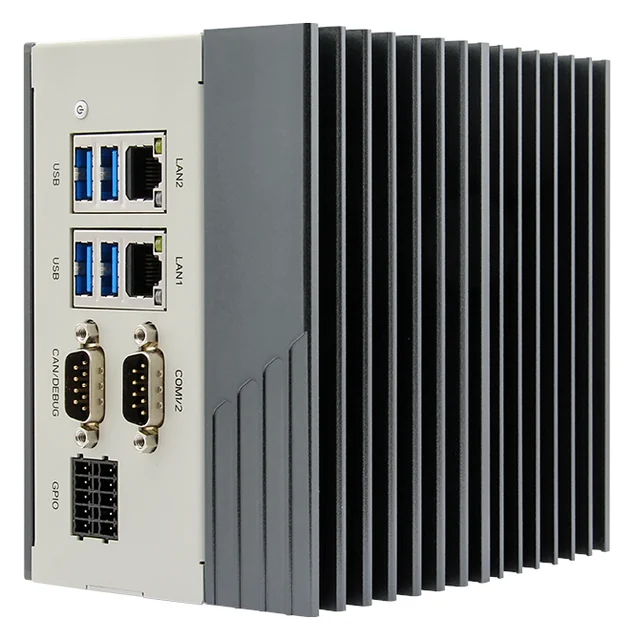
Drive data is read over EtherCAT or Modbus TCP by the PLC or directly by the edge AI computer. The two separate LAN ports of the Nexcom COEUS-3721T keep the machine network and the plant network apart; the RS232/422/485 and CAN ports can be used to collect data from older devices and CAN equipment. The model runs on the Jetson Orin Nano under Linux; data and warnings stay inside the plant.
If the machine already has a CODESYS-based control system, cycle-by-cycle current and torque traces are collected in the PLC and passed to the edge computer; the machine's control cycle is not affected by this analysis.
Drives and motors
Drives with EtherCAT communication; the raw data for predictive maintenance, such as current, torque, speed, temperature and fault logs, is already available inside the drive.
Edge AI computer
Nexcom COEUS-3721T: fanless box PC, NVIDIA Jetson Orin Nano 4 GB (512-core Ampere GPU; manufacturer rating 34 TOPS, INT8, Super mode), 2 × GbE, 4 × USB 3.0, HDMI, 4 DI / 4 DO, RS232/422/485, CAN, 9–30 V DC, DIN rail. Models run on the GPU with TensorRT or ONNX Runtime under Ubuntu 22.04 and JetPack 6.2; images never leave the plant.
PLC and motion control
The decision goes to your existing PLC via a digital output, Modbus TCP or OPC UA. In small cells, CODESYS Control for Linux ARM64 SL can run as the PLC on the same Jetson device.
Image processing and model software
Image acquisition and pre-processing with Python and OpenCV, YOLO-family detection and segmentation models, labelling, training and model version control; the operator screen and logging interface are written by ONX.
Feasibility and pilot
In predictive maintenance, the feasibility study is carried out not with images but with your machine's data: the axes to be monitored are selected, the data readable from the drives is identified, and data from healthy operation is collected for a period. The model is built on this data, and warning thresholds are set together with you so that false alarms do not overwhelm the maintenance team.
If you have failure history records (which axis, when, which part was replaced), the model is validated against them. During the pilot phase, warnings are only logged; notifications are enabled after they have been compared with the maintenance team's findings.
Adding it to an existing line
Predictive maintenance is generally added to machines already in operation and touches the machine's control software very little. Drive data is read from the existing network; for older drives not connected to a network, a communication card is added or the drive is replaced. The vibration sensor is mounted on the motor or bearing housing.
- Selecting the axes to monitor based on downtime cost and failure history
- Identifying the data readable from the drive and the network connection
- Adding vibration and temperature sensors where needed
- Collecting healthy operation data and building the model
- Connecting warnings to the operator screen, the maintenance team or the maintenance management system
Together with ONX solutions
This application connects directly to the motion control of the machines and lines ONX builds. How the vision or data result feeds the PLC, servo axes and EtherCAT network in these solutions:
Flying shear and cut-to-length + vision measurement
The length and cut quality of every piece can be measured by camera at the end of the line. The trend of the measured deviation is fed back to the flying shear's cut-length correction, so measuring-wheel slip or wear is caught before parts drift out of tolerance. The servo torque trace of each cut cycle shows the condition of the carriage, blade and drive mechanics for predictive maintenance.
Winding, slitting and extrusion + surface defect detection
Defects on film, foil, paper or strip are recorded on the same position axis as the winder's metre counter and the line encoder. Each reel's defect map is therefore stored together with its tension and speed log, and the cause (tension swings, a splice, the die) can be traced on one timeline. On a slitting line the defective section can be removed at the reel change.
Drives and maintenance contracts + predictive maintenance
On machines ONX builds and maintains, drive data is already on EtherCAT. Current, torque, temperature and vibration traces are monitored on the edge AI computer, and deviation alerts feed the planned visits in the maintenance contract. In retrofit projects, data collection can be built into the architecture from the start.
Frequently asked questions
Do we have to fit additional sensors?
Not always. Most data such as current, torque, speed and temperature is available in the drive and reveals problems such as friction, jamming and increased load. For early signs of mechanical faults such as bearing and gear wear, a vibration sensor is recommended.
We have no failure data. How will the model learn?
The model first learns from the machine's healthy operation and flags deviations from normal; no failure examples are needed for this. Over time, as the maintenance team's findings are recorded, the causes behind warnings are interpreted better.
What if there are too many false alarms?
During the pilot phase, warning thresholds are set together with your maintenance team, and warnings are initially only logged. Because recipe and speed changes are given to the model as operating states, normal production changes do not generate alarms.
Does the data go to the cloud?
No. Data collection and the model run on the edge computer inside the plant; warnings are delivered over the plant network to the operator screen or the maintenance team.
Does it work with drives from different manufacturers?
Whether data can be read depends on the drive's communication capabilities. Data can be read from most drives that provide it over EtherCAT or Modbus TCP; which data can be read and at what rate is determined in the project according to the drive model.
Let us start with the machine whose downtime costs you most
Machine type, number of axes, drive models and any failure history are all we need; we will come back to you with a monitoring plan.