
 Control Techniques
 Estun Automation
 CODESYS
 Crevis
 Nexcom / Nexcobot
 Leroy-Somer
 Servo Systems
 AC Drive + Motor
 DC Drives
 Smart PLC
 Panel PC / IPC
 Remote I/O
AI Quality Inspection for Concrete Paving Block and Kerb Production
By the ONX Control engineering team · Last updated:
In short
In concrete paving block (interlocking paver) and kerb production, quality is usually checked by sampling hours later, after the blocks leave the curing chamber; by then, pallets produced with the same fault are already curing. AI quality inspection scans every pallet right at the vibro-press outlet while the blocks are still wet: it finds broken corners, cracks, incomplete filling and surface defects in the camera image with deep learning, measures the height of every block with a laser line and a camera, and reports the result to the operator in real time against the pallet number. ONX Control builds this system with a Linux-based edge AI computer, a global shutter GigE camera and a laser line projector.
How it works
The measuring station is installed on the pallet conveyor between the vibro-press and the curing chamber. As the pallet passes, a laser line is projected across the blocks and an image of the top face is captured at the same time. Image capture is triggered by a pallet sensor or the conveyor encoder, so every image line is tied to a row on the pallet. A global shutter camera and short exposure keep the image of the moving pallet free of distortion.
Height is measured by laser line triangulation: because the camera views the laser line at an angle, the line shifts in the image when it falls on a higher surface. Calibration converts this shift into millimetres, and the height of every block is calculated relative to the pallet surface. Keeping block height consistent and close to the minimum the standard allows affects both quality and concrete consumption directly; a drift in height is usually the first sign of a change in filling, vibration time or mix.
Surface defects are found with a deep learning model: broken or missing corners, edge and surface cracks, incomplete filling, pores and voids, and spalling or colour differences in the coloured face mix. Because wet concrete reflects light and its tone changes as it dries, rule-based methods struggle here; the model is trained for your product types and colours on your own good and defective blocks. A separate recipe is kept for every product type (mould).
Results are logged with the pallet number, mould and shift; the operator screen shows the defect map and height trend of the latest pallets. An alert is raised when height approaches the minimum or when a defect repeats in the same mould cavity, so the press setting can be corrected or the mould checked before the problem spreads through a whole batch. Defective blocks can be flagged with pallet and position data for removal at the cubing stage after curing.
-
1
Pallet detection
When a pallet enters the measuring station, a sensor or encoder starts image capture.
-
2
Height by laser line
The shift of the laser line is converted into the height of each block, relative to the pallet surface.
-
3
AI surface inspection
The model finds broken corners, cracks, incomplete filling and surface defects on the wet top face.
-
4
Pallet record and alert
The result is logged against the pallet number; the trend is shown to the operator and an alert is raised when a limit is crossed.
Critical parameters
| Parameter | Why it matters | Value |
|---|---|---|
| Press cycle time and pallet speed | Determine how many images and laser profiles are captured as the pallet passes and the camera's exposure time. | Defined per project |
| Product type, size and layout | Determine the field of view, the number of cameras and lasers, and the recipe for each mould. | Defined per project |
| Height tolerance | Determines camera resolution, the angle between laser and camera, and the calibration method; measurement uncertainty is verified with reference blocks. | Defined per project |
| Defect types and colours | Coloured face mix, texture and wet-surface reflection determine the lighting geometry and the model's training data. | Defined per project |
| Environment | Dust, humidity, vibration and ambient light determine the camera and laser housing, mounting and cleaning plan. | Defined per project |
Values are determined in a feasibility study on your line with your products; this page makes no general accuracy or savings promise.
ONX architecture
The laser line projector and the global shutter camera are mounted above the pallet conveyor in a housing protected against dust and moisture; images reach the edge AI computer over GigE. The Nexcom COEUS-3721T in stock (NVIDIA Jetson Orin Nano) runs the height profiling and the surface model under Linux; the global shutter Crevis MG-A121K-9 in stock is a suitable camera for moving pallets. Wide pallets or multi-row layouts use several cameras and lasers.
Results are written to the operator screen and a database. A link to the press PLC (pallet number, mould data, alert signal) can be made via Modbus TCP, OPC UA or a digital signal; which data is shared with the press and how the alert is used are decided together in the project.
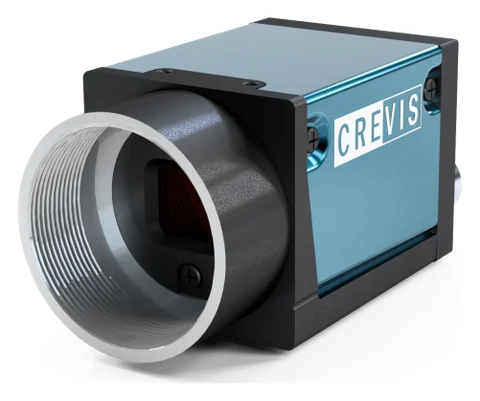
GigE industrial camera and optics
Crevis MG series GigE Vision cameras and 12 MP lenses. Resolution, sensor type (rolling or global shutter), lens and lighting are selected according to the smallest defect and the line speed. The MG-A121L-9 (Sony STARVIS IMX226, rolling shutter + Global Reset) and MG-A121K-9 (Sony Pregius IMX304, global shutter) in stock are powered over PoE on a single cable and triggered from an encoder or photocell through their external trigger input.
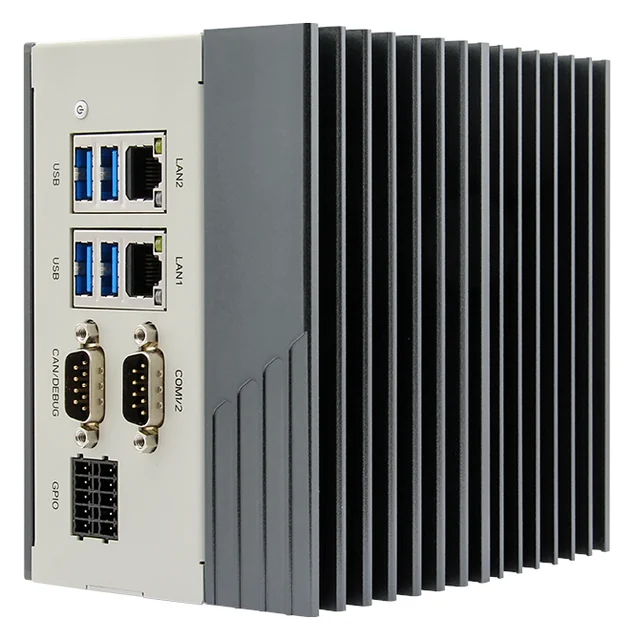
Edge AI computer
Nexcom COEUS-3721T: fanless box PC, NVIDIA Jetson Orin Nano 4 GB (512-core Ampere GPU; manufacturer rating 34 TOPS, INT8, Super mode), 2 × GbE, 4 × USB 3.0, HDMI, 4 DI / 4 DO, RS232/422/485, CAN, 9–30 V DC, DIN rail. Models run on the GPU with TensorRT or ONNX Runtime under Ubuntu 22.04 and JetPack 6.2; images never leave the plant.
Laser line projector
Industrial projector that casts a laser line across the blocks; the camera views the line at an angle and its shift gives the height. Wavelength, line width and power are selected for the product colour and ambient light.
Image processing and model software
Image acquisition and pre-processing with Python and OpenCV, YOLO-family detection and segmentation models, labelling, training and model version control; the operator screen and logging interface are written by ONX.
Feasibility and pilot
What decides the success of an AI project is your product, your lighting and your line speed, not a catalogue figure. That is why every project starts with your own samples: first, images are collected on the bench with the right camera, lens and lighting, an initial model is trained, and the false reject and miss rates are measured on your parts. If the result meets the acceptance criterion, the system runs on the line as a pilot, initially in a mode that only logs and makes no decisions.
For paving block projects, feasibility is carried out with pallets from your own line: images are collected from different product types and colours and from good and defective blocks; height measurement is compared with reference blocks of known size and with calliper measurements after curing. During the pilot the system only records for a while; alerts are switched on after the results have been compared with your quality team's checks.
Adding it to an existing line
The system is added to a running vibro-press line, on the pallet conveyor between the press and the curing chamber; the press itself and the moulds are not touched. A bridge for the camera and laser above the pallet conveyor, a pallet detection sensor and an operator screen are all that is needed.
- Measuring the station position, pallet speed and cycle time on the pallet conveyor
- Installing the camera and laser bridge in housings protected against dust, moisture and vibration
- Taking pallet detection and pallet number data from a sensor or the press PLC
- Recipe, height tolerance and calibration for every product type
- A record-only pilot first, then switching on the alerts
Frequently asked questions
Why is inspection done before the curing chamber?
Inspection after curing shows a defect hours later; by then, pallets made with the same setting are already curing. Inspection right at the press outlet shows the defect within minutes, so a press setting or mould problem is corrected before it spreads through a whole batch.
Is the height measured on wet blocks reliable?
The measured value is the height of the block as it leaves the press and directly reflects the press's filling and vibration settings. Because its relation to the cured value depends on the product and mix, wet measurements are compared with calliper measurements after curing during the pilot and, if needed, a correction is defined per product type.
Does it work with coloured and textured products?
Yes. The model is trained on your products for each product type and colour, and a recipe is kept for every mould; spalling and colour differences in the coloured face mix can also be tracked as a separate defect class.
Are defective blocks removed from the line?
Wet blocks are not touched; the system logs defective blocks with pallet and position data. Removal can be done at the cubing stage after curing, based on this record. The main gain is seeing the source of the defect right at the press outlet.
Do dust and moisture affect the camera?
The camera and laser are protected against dust and moisture in housings, with an air curtain if needed; the cleaning interval for the lens and housing window is part of the maintenance plan. Calibration is verified periodically with reference blocks.
Let's talk feasibility for your vibro-press line
Product types, pallet size, press cycle time and a few good and defective blocks are enough; we will come back with a measuring station and a feasibility plan.