Rotary Knife Automation
In short
A rotary knife (rotary shear) cuts continuously moving material without stopping the line, using one or more blades on a constantly rotating drum. At the moment of cutting the blade matches its peripheral speed to the material speed; between cuts it speeds up or slows down according to the required length. ONX Control builds this motion with CODESYS SoftMotion electronic cam profiles, EtherCAT and servo drives.
How it works
Material speed is read from a line encoder or the feed axis and used as the master axis. The knife servo is coupled to this axis through an electronic cam that defines the speed profile over one revolution.
If the cut length equals the knife circumference (taking the number of blades into account), the knife turns at constant speed. For longer lengths it slows down or dwells between cuts; for shorter lengths it accelerates outside the cutting zone. Motor torque and heating therefore depend strongly on the ratio of cut length to knife circumference.
-
1
Synchronous cutting zone
Within the angle where the blade enters the material, peripheral speed equals line speed, so the material is not crushed, pulled or torn.
-
2
Correction zone
Outside the cutting zone the knife accelerates or decelerates to reach the next cut point on time.
-
3
Profile recalculation
When the cut length changes, the controller recalculates the cam profile; no mechanical adjustment is needed.
-
4
Registration correction
On printed material, the cut point can be corrected every cycle from the offset measured by a registration mark sensor.
Critical parameters
| Parameter | Why it matters | Typical range / ONX field data |
|---|---|---|
| Line speed | Sets the knife's peripheral speed in the synchronous zone and the motor speed. | Defined per project |
| Cut length tolerance | The sum of encoder resolution, material slip and cam following error. | Defined per project |
| Cycle rate (cuts per minute) | Together with knife speed and number of blades, determines the acceleration in the correction zone. | Defined per project |
| Cut length / knife circumference ratio | The further the ratio is from 1, the more the knife must accelerate and decelerate every revolution and the higher the motor's RMS torque. | Defined per project |
| Number of blades and drum inertia | Determine motor and gearbox selection and therefore the shortest achievable cut length. | Defined per project |
ONX architecture
The knife axis is coupled to the master axis by an electronic cam defined in CODESYS SoftMotion; the cam profile is calculated from cut length, knife diameter and number of blades. The controller runs as CODESYS Control RTE on an industrial PC, with drives and I/O connected over EtherCAT.
ONX Control uses its own CODESYS-based function block (ONX Motion Library) for rotary knife motion; details are described on codesysturkiye.tr.

CODESYS SoftMotion
Electronic cam (MC_CamIn) with the cam table recalculated during operation.

Industrial PC
Industrial PC or panel PC running CODESYS Control RTE.
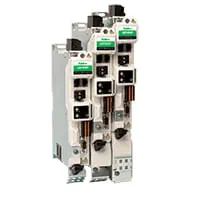
Servo drives
High-dynamic servo drives with EtherCAT communication.
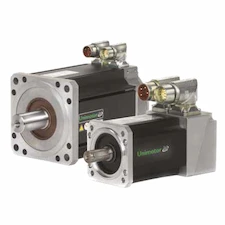
Servo motors and sizing
Motor selection by RMS torque calculation from drum inertia and cam profile.
Field reference
The videos below are field footage of rotary knife applications from ONX Control's YouTube channel: the knife runs synchronized to line speed over CODESYS and EtherCAT.


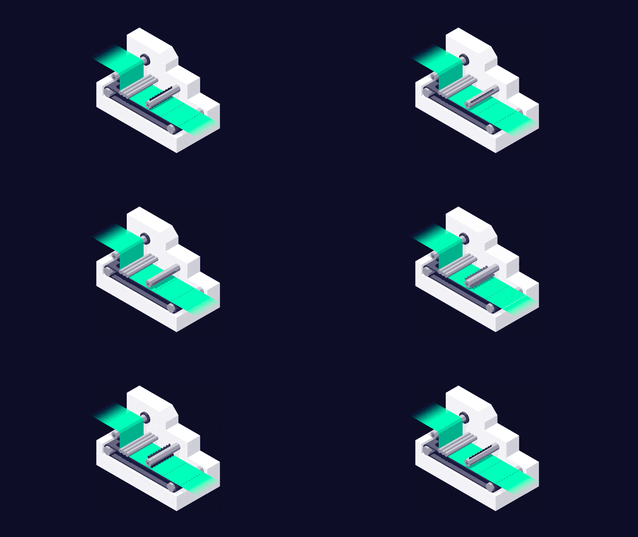
Principle illustrations
Retrofit scenario
On older rotary knives driven by a mechanical gearbox, clutch-brake or change gears, changing the cut length requires mechanical adjustment and downtime. When converting to a servo drive the knife drum is usually kept, and length changes are made in software by recipe.
- Measuring drum inertia, number of blades and the existing drive train
- Sizing servo motor and gearbox for the target cut length range
- Replacing the mechanical synchronous link with an electronic cam
- Adding a line encoder and, if needed, a registration mark sensor
- Moving cut length recipes to the operator panel
Frequently asked questions
What is the difference between a rotary knife and a flying shear?
On a flying shear the cutter moves back and forth on a linear carriage; on a rotary knife the blade keeps turning in the same direction. With no return stroke, a rotary knife suits short lengths and high cycle rates, while a flying shear is preferred for thick sections and saw cutting.
What happens if the cut length is very different from the knife circumference?
The knife has to accelerate and decelerate more on every revolution, which increases the motor's RMS torque and heating. Motor and gearbox must be sized for this ratio.
Do we need a separate cam controller?
No. CODESYS SoftMotion runs the cam tables in the controller on the industrial PC; when the cut length changes, the profile is recalculated in software.
How is the cut aligned to the print on printed material?
A sensor reads the registration mark; the measured offset is added to the cut point as a correction every cycle, so errors do not accumulate.
What information is needed for a quote?
Material type, line speed range, cut length range, required tolerance, knife diameter and number of blades, drum inertia (or weight and dimensions) and the existing drive system are enough for a first assessment.
Discuss your rotary knife project with our engineers
Share your cut length range, line speed and knife drum data; we will come back with motor sizing and an architecture proposal.