Strip and Wire Accumulator Control
In short
An accumulator is a material store on a continuous line that keeps the exit process running while the entry section stops for a coil change or strip weld. In normal operation it holds a set amount of strip or wire; when the entry stops, the exit is fed from this reserve, and when the entry restarts it runs faster than the exit to refill the accumulator. ONX Control controls the fill level, the entry/exit speed relation and the tension during filling and emptying with CODESYS, EtherCAT and AC/servo drives.
How it works
In tower (vertical) and festoon accumulators, the material runs in several strands between a fixed roll set and rolls on a moving carriage. With N strands, the stored material is roughly N × carriage position, and the carriage speed is v(carriage) = (v(entry) − v(exit)) / N. When the entry is faster than the exit, the carriage opens and the accumulator fills; when it is slower, the carriage closes and the accumulator empties. On wire lines the same principle is applied with dancer-type accumulators or storage capstans.
Tension comes from the force on the carriage being shared between the strands: the carriage is loaded by a drive motor, a pneumatic cylinder or a counterweight. During filling and emptying, carriage acceleration and roll friction change strand tension; on a driven carriage the motor torque is set with these effects taken into account. Entry and exit usually have bridle roll sets, which split line tension into zones and through which the speed references are applied.
-
1
Normal running
Entry speed matches exit speed and the accumulator is held at its target fill level; the level error is added to entry speed as a small correction.
-
2
Entry stop and emptying
The entry decelerates and stops for coil end or welding; the exit continues at the same speed while the carriage closes and releases the reserve.
-
3
Restart and filling
The entry restarts and runs faster than the exit; the difference refills the accumulator to its target level.
-
4
Limit protection
If the accumulator approaches empty, exit speed is reduced in steps; at full, the entry is limited. The carriage approaches its end positions smoothly.
Critical parameters
| Parameter | Why it matters | Typical range / ONX field data |
|---|---|---|
| Line (exit) speed and entry fill speed | Exit speed sets the material consumed while the entry is stopped; the speed difference between entry and exit sets how quickly the accumulator refills. | Defined per project |
| Tension tolerance | Depends on the resolution of the carriage force, the effect of carriage acceleration and roll friction; sets the risk of breaks or slack in thin strip and wire. | Defined per project |
| Cycle (coil change / weld frequency and duration) | How often and how long the entry stops determines the required reserve and the time left for refilling. | Defined per project |
| Storage capacity | Set by strand count and carriage stroke; it must be at least exit speed multiplied by entry stop time, plus ramp margins. | Defined per project |
| Fill level measurement | Carriage drive encoder, absolute encoder or laser distance sensor; determines the stability of level control and the reliability of limit protection. | Defined per project |
ONX architecture
In the ONX architecture, level control, entry and exit speed references and the carriage tension calculation run in CODESYS on an industrial PC or compact controller. Entry and exit bridle drives and the carriage drive are controlled over EtherCAT in speed or torque mode; carriage position and tension signals are read through remote I/O.
The coil change and welding sequence at the entry is managed in the same program as the accumulator level: the controller tracks the remaining reserve and exit speed, calculates when the entry can stop and how long refilling will take, and shows this on the operator screen.

CODESYS
Fill level PID loop, entry/exit speed relation, carriage tension calculation and limit protection.


AC and servo drives
Drives for bridle and carriage that can run in speed and torque mode; Unidrive M700 joins the EtherCAT network through the SI-EtherCAT module.

Motors
AC induction motors for bridle and carriage drives.
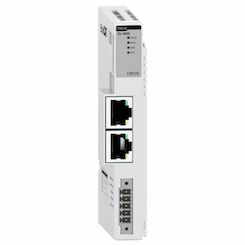
Remote I/O
EtherCAT remote I/O for carriage position sensor, load cell, limit switches and welding station signals.
Field reference
The image below is a principle illustration of how an accumulator fills and empties.
Principle illustrations

Retrofit scenario
A typical picture on older accumulators: level sensed only by a few limit switches, entry speed changed in steps, tension spikes at the transition between filling and emptying, or DC-driven bridles. In a retrofit the tower, carriage and rolls are kept; continuous position measurement is added, the drives are renewed and level control moves to CODESYS.
- Reviewing strand count, carriage stroke, carriage mass and loading method
- Adding continuous carriage position measurement (encoder or laser distance sensor)
- Renewing bridle and carriage drives, or converting DC drives to AC
- Moving level and tension control to CODESYS and linking the coil change sequence
- Commissioning with tension logging during entry stop, refill and acceleration
Frequently asked questions
When is an accumulator needed?
When stopping the exit process (galvanizing, coating, roll forming, wire drawing and similar) causes quality loss or scrap, and the entry regularly stops for coil changes or strip welding. As long as the entry is stopped, the exit keeps running on the reserve in the accumulator.
How is accumulator capacity calculated?
The required reserve is at least exit speed multiplied by entry stop time, plus the entry deceleration and acceleration ramps and a safety margin. In tower and festoon types, capacity is set by strand count multiplied by carriage stroke.
Why does tension change during filling?
During filling and emptying the carriage accelerates and decelerates, so its inertia puts extra force on the strands, and roll friction changes with direction of travel. On a driven carriage the motor torque is set with these effects taken into account, so strand tension is held while the carriage moves.
What happens if the accumulator runs empty?
The controller tracks the remaining reserve continuously; as it approaches empty it reduces exit speed in steps and, if needed, stops the line in a controlled way. The carriage therefore does not hit its end stop and the material does not go slack.
What information is needed for a quote?
Accumulator type and strand count, carriage stroke and mass, material and cross-section, line speed, tension range, coil change or welding time and the existing drive and control system are enough for a first assessment.
Discuss your accumulator project with our engineers
Share your line speed, entry stop time and accumulator dimensions; we will come back with a capacity check, drive selection and an architecture proposal.